Court Grants Preliminary Injunction Blocking Enforcement of New Mexico’s PFAS Disclosure Rule
By:
In 2025, New Mexico passed its PFAS Protection Act. The law includes, with some exceptions, a ban on products containing intentionally added PFAS. That portion of the law takes effect on a rolling basis beginning January 1, 2027. First, cookware, food packaging, dental floss, products for children, and firefighting foam will be banned. Next, on January 1, 2028, other items like carpet, cleaning items, and cosmetics will be banned, and eventually, by 2032, virtually all products that don’t meet an exemption will be banned. By 2027, companies also must begin reporting products’ PFAS content to the state. Finally, the law allows the state’s Environmental Improvement Board (EIB) to create rules on the labeling of products containing PFAS.
A recent decision by the federal district court in New Mexico involves only the EIB’s rulemaking. In May 2026, the EIB passed a final rule (N.M. Code R. § 20.13.2.13) requiring products with intentionally added PFAS to bear an image of an Erlenmeyer flask with “PFAS” written on it:
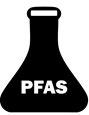
Several product categories, including medical devices, veterinary products, and used items, are exempt. The American Chemistry Council, as part of a coalition of trade associations, sued New Mexico officials and, in doing so, sought a preliminary injunction preventing enforcement of the rule, based on First Amendment grounds. In order to secure a preliminary injunction, the moving party must show a likelihood of success on the merits and likelihood of irreparable harm in the absence of the injunction. The moving party must also show that the balance of the equities is in its favor and that the injunction will serve the public interest. The bulk of the court’s discussion focused on the first of these factors.
The court began by acknowledging various First Amendment standards at play. First, under U.S. Supreme Court precedent, the First Amendment protects not only speech, but also “the right to refrain from speaking at all.” Second, while commercial speech is protected, it is to a lesser degree than non-commercial speech, prompting courts “to apply less scrutiny.” Third, governmental mandates for disclosure of “purely factual and uncontroversial information” garner even less scrutiny, requiring the state to show only that there is a reasonable fit between the means used to achieve the state interest and whether the mandate avoids being so “unjustified or unduly burdensome” as to “chill protected speech.” Finally, under relevant precedent, the state interest must be in remedying a “harm that is potentially real and not just purely hypothetical.” Thus, “consumer curiosity is not a sufficient government interest to sustain the compulsion of even a factually accurate and non-controversial statement.”
Against this legal framework, the Plaintiffs argued that the required PFAS disclosure failed to be purely factual and uncontroversial, where “there is no universally accepted definition of PFAS” and the “graphic image conveys a warning that all PFAS that are labeled are dangerous” which “is not accurate.” The court rejected both arguments. It reviewed definitions of PFAS from the EPA and various laws, including the New Mexico law, and concluded that enough agreement existed that PFAS is a “substance in a class of fluorinated organic chemicals containing at least one fully fluorinated carbon atom.” The court next held that the PFAS disclosure was uncontroversial where it “does not require Plaintiffs to convey any information at all about any alleged risks or harm that PFAS might cause.” As such, according to the court, the regulation “does not require mandated speech to weigh in on the scientific debate.”
However, that the rule was held uncontroversial was its ultimate undoing. New Mexico argued that its state interest was in “consumer awareness,” as well as “consumer health and safety and the protection of the environment.” Specifically, “when informed that a product contains intentionally added PFAS, consumers may reduce their environmental footprint or make healthier lifestyle choices.” The court pulled no punches in observing that “[b]luntly, Defendants’ characterization of the innocuous nature of the label suggests the state’s interest is akin to mere consumer curiosity.” The court continued, “In characterizing the required label as a ‘consumer awareness label,’ and not a ‘warning label,’ Defendants destroy the connection between the purpose of the required label—to promote consumer and environmental health—and the means employed to realize that purpose, which in other instances is achieved with a warning.” The court pointed to and agreed with a prior decision finding that if mere consumer awareness were a sufficient state interest, there would be “‘no end’ to the type of labelling requirements the state could impose.”
Thus, the court found that the Plaintiffs were unlikely to succeed in showing that the New Mexico rule requires disclosure of controversial information that is more than purely factual. However, by the same token, the court held that such an innocuous disclosure failed to move the needle on protecting consumer or environmental health. The court, finally, found that irreparable harm was likely and that a balance of the equities and the public interest weighed in favor of the injunction. The court granted the preliminary injunction, preventing enforcement of the rule while the litigation proceeds.
Authors

-
Katie Bond is a Partner with Keller & Heckman in the firm’s Washington, D.C. office. She counsels clients on food, drug, advertising, and labeling regulations with extensive experience in matters related to the U.S. Federal Trade Commission (FTC), U.S. Food and Drug Administration (FDA), and other regulatory bodies.
- Learn More

-
Samuel A. Butler is an Associate with Keller & Heckman in the firm’s Washington, D.C. office. He works with clients to analyze and manage risks related to product labeling and marketing, with a particular focus on health, nutrition, and environmental advertising in the supplement and consumer product industries.
- Learn More