The Economic Irrationality of “Surveillance Pricing”: How Bans on Personalized Prices for Groceries Will Make Groceries Cost Even More
By:
Governor Mikie Sherrill was mad about groceries. In late July, standing in a grocery store, the recently elected New Jersey governor railed against the sky-high cost of food. Across the board, the state’s residents were paying 3.2% more than they had the year before. And the cost of common staples was even worse. Poultry, fish, and eggs were up 4.7%, ground beef 14.9%, roast beef a whopping 21.2%. And Sherrill thought she knew the cause: “surveillance pricing.” Grocery stores, she said, were using high-tech algorithms to spy on their customers and set their prices at individual “pain points.” This practice, she claimed, “essentially gives Big Brother a look into your shopping cart. It’s incredibly invasive, and it’s expensive.” So she was there, standing at the epicenter of the problem, to sign a law making surveillance pricing illegal.
There was only one problem: surveillance pricing doesn’t actually raise prices. Because grocery stores compete vigorously with each other, they can’t raise their prices above the market level. If they do, their customers will immediately walk across the street and buy for less. Their ability to “discriminate” against even high-income consumers is extremely limited. So when they do look at personal data, they almost always use it to target discounts. That is, they find consumers who won’t pay the market rate and cut them a deal. And that means the bill Sherrill signed won’t save consumers any money. Quite the opposite: it will probably force them to pay more.
That result would be a shame even if it were limited to the Garden State. But it’s not. Surveillance-pricing bans are sweeping the country, carried along by angst over food prices and hostility toward technology. And as these bans spread, they will only make grocery prices worse. Pricing systems will become less efficient, consumers will miss discounts, and the market will lose a tool that could have benefitted everyone. Public-policy failures are rarely so complete.
Coupons and Conspiracies
Few policies have taken off faster than surveillance-pricing bans. A year ago, these bans were unheard of: not a single State regulated surveillance pricing. But since last December, three have enacted bans: Maryland, Connecticut, and New Jersey. Another ban recently passed the New York legislature. And according to one count, nearly a dozen other States are considering their own surveillance-pricing laws.
These laws mostly work the same way. In broad terms, they forbid a company from using a consumer’s personal information to set a price. The company can still offer certain group discounts, like those for veterans, seniors, or students. The company can also generally offer discounts to people who sign up for loyalty programs. But those exceptions aside, the company cannot offer different prices to different people: the price for everyone should be the same.
So far, the enacted laws have focused mainly on the grocery industry. That focus is driven in part by angst over lingering pandemic-era inflation. Though the pandemic’s supply shocks have mostly subsided, grocery prices have stuck at higher levels. And consumers have grown increasingly suspicious that something else must be going on.
Seizing on that feeling, state lawmakers have pointed the finger at surveillance pricing. They say that by leveraging personal data, grocery stores have been able to calibrate prices to individual consumers. These personalized prices have allowed them to maximize profits at the expense of vulnerable shoppers, who are already straining under the weight of economy-wide inflation. So the time has come, they say, to ban surveillance pricing.
Discount Aisle Meets Dismal Science
The only problem with this story is that it’s economic nonsense. High grocery prices have nothing to do with surveillance pricing. High prices instead reflect economy-wide pressures, like tariffs, high labor costs, and general inflation. And in fact, by interfering with the market’s ability to set prices, these States might drive grocery prices even higher.
The reason is textbook economics. Under standard price theory, each person has a “reservation price”—the price he or she is willing to pay for a product. Because consumers value products differently, they may have different reservation prices for the same product. Producers would love to sell their products to these consumers at each of their respective reservation prices. But they generally can’t do that. They sell their products on the open market: they can change a price for one consumer only by changing a price for all consumers. They have to sell at a price giving them a reasonable return without chasing their consumers off to other sellers.
To some extent, the surveillance-pricing bans account for that dynamic. They theorize that grocery stores are using consumer data to find each consumer’s individual reservation price. If a store has a consumer’s data, it has a better idea of what the consumer is willing to pay. So the store can set its price at just the right cutoff point, charging at least some consumers more.
But that theory doesn’t account for the most important constraint on prices: competition. In a competitive market, no firm can charge a consumer a higher price—regardless of how much it knows about the consumer—if the consumer can walk across the street and buy the same product for less. For example, your local coffee shop may know that you are (theoretically) addicted to caffeine. It may also know that if you’re forced, you will pay a lot of money to get your fix. But the coffee shop still can’t charge you more than the market price. If it tries, you’ll just step next door and buy your joe from someone else. Competition sets a natural limit on prices.
Why, then, would a company ever use personal data to set a price? Again, the answer comes from a textbook economic insight: average costs are different from marginal costs. While average costs are what a company spends to make each widget, marginal costs are what the company spends to make one additional widget. These costs are different because some expenses—“fixed costs”—mostly affect average costs. For example, think again about the coffee shop. The shop needs to buy a commercial grinder. The cost of that grinder gets spread across every cup of coffee it sells, raising the average cost. But the marginal cost for each additional cup is mainly just the cost of beans and water—a few cents at most. So the marginal cost of each cup is several orders of magnitude smaller than its average cost.
In many industries, that gap pushes businesses to produce as much as possible. By selling more, they can spread their fixed costs and drive down their average costs. But that strategy works only to a point. To sell more on the market, they have to cut their price. And if the price falls too far, it might sink below the average cost. Selling more units becomes unprofitable, even if there are still some consumers who would buy an extra unit for more than that unit’s marginal cost.
That’s where personalized prices come in. If the company can find these below-average-cost consumers, it can send them discounts. Those discounts bring down the product’s price to the consumer’s individual reservation price. Selling at that price is still profitable because the consumer still pays more than the marginal cost. And because the price is personalized, the business can offer it to that consumer without slashing its market price below its average costs.
Notice what all this implies. Personalized pricing allows a company to offer targeted discounts. But it does not allow the company to offer targeted price hikes. If the company tries to charge a consumer more than the market price, the consumer can still buy from someone else. He or she will pay a personalized price only when that price is below market. The consumer pays less, not more.
Thin Margins, Thick Competition
Policymakers sometimes respond to all this by denying the existence of competition. Sure, they say, firms can’t hike their prices in competitive markets. But the grocery market isn’t competitive: it is dominated by a handful of giant firms who control access and set prices at will. And because these firms don’t fear competition, they can use personal data to target people willing to pay more.
But that argument has two problems. The first is that its vision of the grocery industry is basically fictional. It imagines grocery firms as quasi-monopolies feasting on fat profit margins. In the real world, however, grocery retailers’ margins are “razor thin.” On average, they earn a margin of only 1.7%—a meager sum compared with the margins seen in other major sectors:
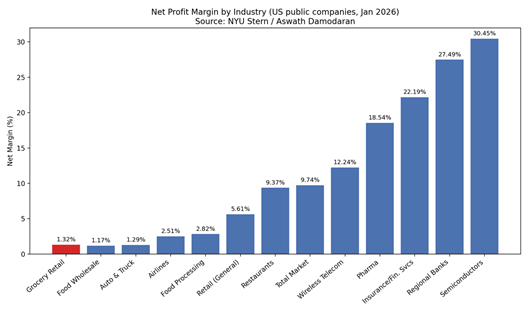
As this chart shows, grocery margins are some of the thinnest in the economy. Even notoriously competitive industries like the restaurant business have much higher margins. That suggests a high degree of competition and a low degree of pricing power. In fact, if you were trying to pick the industry least able to systemically price above the market rate, the grocery industry might be it.
Some critics say that these numbers don’t tell the whole story. They argue that margins are likely to rise in the future because the industry is becoming more concentrated: grocery firms are merging (or trying to merge), and their bigger size will, over time, give them more pricing power. But on the ground, there’s little evidence that grocery profits are fattening. The most critical study of the issue was conducted by the Federal Trade Commission in 2024, which found some evidence of higher profits. The report speculated that the increase might have been caused in part by industry consolidation. But even the FTC admitted that the study couldn’t tie higher prices to higher profits directly because it failed to tease out whether prices had risen more than costs. In other words, higher grocery prices could have owed entirely to higher costs for inputs, like wholesale food and labor.
That brings us to the second problem. Even if the industry were consolidated as the critics suggest, a ban on surveillance pricing wouldn’t bring down prices. In that scenario, grocery firms would already have pricing power. They could raise prices without getting stung by lower-cost competitors. So if they couldn’t raise their prices using personal data, they would just raise prices the old-fashioned way: by marking up their prices across the board. What’s more, that strategy would most hurt lower-income consumers, who would struggle the most to pay the new baseline prices. And these consumers, coincidentally, are the same people surveillance-pricing bans are supposed to help.
But that’s what often happens when policymakers play with prices. Prices are a signal: they tell people when, where, and what to buy and sell. When policymakers try to manipulate them, they scramble the signal. It is a lesson we’ve learned before and seem destined to learn again.
Author

-
Alex MacDonald is an attorney in private practice in Washington, D.C.