Time to Revisit the “Bill of Costs” Statute: Electronic Data Expansion Requires New Approach to eDiscovery Cost Recovery
By:
The federal “bill of costs” statute (28 U.S.C. § 1920) allows prevailing parties to recover certain discovery costs incurred during litigation, including “fees for exemplification and the costs of making copies of any materials where the copies are necessarily obtained for use in the case.” In federal court such costs, other than attorneys’ fees on federal civil judgments, are recoverable both in actions for monetary damages and injunctive relief. 0 However, the statute has not been updated since 2008 and no longer reflects the landscape and proliferation of electronic data requested during discovery.
The Framework and Application Recovery
Federal Rule of Civil Procedure 54(d)(1) provides that costs other than attorneys’ fees should be allowed to the prevailing party. This rule permits successful parties in federal court to recover certain categories of litigation expenses, most commonly sought by parties who prevail on summary judgment or final adjudication. The categories of recoverable costs are governed by 28 U.S.C. § 1920, which outlines the types of expenses that are recoverable.
Under 28 U.S.C. § 1920, recoverable costs include fees paid to the clerk and marshal0, fees for printed or electronically recorded transcripts0, and costs associated with exemplification and making copies of materials that are necessarily obtained for use in the case. 0 The statute also authorizes the recovery of fees for printing and witnesses0, docket fees0, and compensation for court-appointed experts, interpreters, and special interpretation services. 0 To recover these costs, the prevailing party must submit a verified bill of costs to the district court clerk after entry of the final order. The bill must affirm that each recoverable item is correct, was incurred in the litigation, and that the services charged were actually and necessarily performed. 0 In some jurisdictions, local rules may require additional supporting documentation such as court orders, stipulations, or invoices, to substantiate each item in the bill. 0
Recovery of eDiscovery Expenses
The recoverability of eDiscovery expenses under federal cost-shifting statutes remains a contested issue, particularly under 28 U.S.C. § 1920(4), which governs the taxation of certain litigation costs. This provision permits a prevailing party to recover expenses for “exemplification and the costs of making copies of any materials where the copies are necessarily obtained for use in the case.” It is most frequently invoked in connection with discovery-related costs, including those tied to the production of documents. However, § 1920 does not expressly authorize the recovery of eDiscovery costs. Such costs include the process of gathering, preserving, searching, extracting and converting electronically stored information (“ESI”) for purposes of producing copies to litigants in an agreed upon format. Considering this, prevailing parties have sought to characterize eDiscovery costs as “copying costs” and therefore recoverable under § 1920(4) and FRCP 54(d)(1). Courts have generally held that only the conversion of native files to TIFF, the scanning of documents to create electronic images, and the conversion of VHS to DVD (which is far less prevalent in 2025), are taxable as making “copies” of materials under § 1920(4). 0 In contrast, the costs incurred for preliminary or supportive tasks that occur prior to the production of copies, including collecting and preserving electronic data, document review, data processing, and project management, have not historically been considered taxable. 0
Supreme Court’s Opportunity to Clarify. In 2019, the United States Supreme Court attempted to resolve the divide among lower courts by clarifying that eDiscovery expenses are not recoverable as taxable costs under § 1920. 0 Yet discrepancies persist, as district courts have interpreted the decision inconsistently, with some allowing recovery of select eDiscovery expenses under § 1920(4), while others prohibit such recovery entirely. 0 More recently, there have even been splits among judges in the same case. For example, in Marco Contractors, Inc. v. Citizens Fin. Grp., Inc., defendant sought fees for work by a litigation support analyst (employed by the law firm) who provided technical support required to download files and metadata produced by plaintiff, load the files and metadata to the Relativity review platform, analyze the data if and when errors were found in the load files or metadata, and perform searches and filtering in the Relativity review platform. 0 The Special Master acknowledged that the “case assistant” charges were a close question but ultimately held that recovery for a case assistant to “transfer documents to staging area [and/or] process documents to workspace for review” was appropriate. 0 The United States District Court for the Western District of Pennsylvania, however, applied Race Tires and granted plaintiff’s objection to the costs, subtracting the case assistant charges from the final total.
Notably, the district courts that allow for recovery of eDiscovery expenses distinguish between the collection and processing of ESI, which are considered actions performed for the convenience of counsel, with the conversion and exportation of ESI, which are necessary to make one copy for the purposes of § 1920(4). 0 One court even emphasized the importance of requiring eDiscovery vendors to itemize charges in conformity with § 1920. 0 And itemization (or the lack thereof) remains a key theme in recent rulings. 0
A Renewed Emphasis on Vendor’s Itemized Billing
Given the current statutory landscape of § 1920 and its evolving judicial interpretation, we believe the following steps will enable courts to assess and appropriately determine costs for certain eDiscovery activities during the course of litigation.
Vendor billing structures should be properly itemized to allow for maximum recovery under § 1920. In large scale litigations, such as multidistrict proceedings, vendors typically offer a “one size fits all” subscription. For example, billing may be based on only three criteria: (1) in-bound processed data volume (2) professional services, and (3) data volume. Professional service hours in the current eDiscovery context often encompass both technical tasks and data processing activities. In practice, tasks such as document review and project management are frequently interwoven with data processing, conversion, and extraction. As a result, this billing structure that was originally designed to maximize efficiency, now disallows appropriate recovery under § 1920. We propose that eDiscovery invoices should employ detailed line-item billing that differentiates ESI technical services from ESI processing and production.
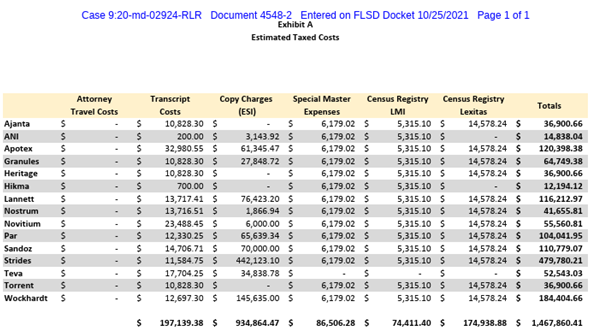
Further, vendors should also separate costs by specific case/jurisdiction. Costs should be itemized on a case-by-case basis so individual invoices can be submitted in the bill of costs. Some firms have sought to recover eDiscovery expenses under § 1920(4) by utilizing an itemized billing structure. For example, in In re: Zantac (Ranitidine) Products Liability Litigation (MDL No. 2924), certain Generic Manufacturing Defendants submitted the following joint bill of costs0 that itemized costs, including “Copy Charges (ESI).”
Vendor Reconciliation
The case law suggests that courts are in favor of litigants itemizing charges in conformity with § 1920. By adopting this itemized billing structure with vendors, organizations can more clearly distinguish recoverable costs for processing native files and preparing materials for production, from non-recoverable technical costs related to organizing and maintaining an electronic database.
Notes
Authors

-
Patrick Oot is a Partner and Co-Chair of the Complex Litigation Strategic Counseling and Government Investigations & White Collar Practice Groups at Shook, Hardy & Bacon L.L.P., practicing across the firm’s Washington, DC, New York, and Boston offices. A Chambers-ranked Star Individual, he is a globally recognized leader in high-stakes MDL, class action, mass tort, and government investigations matters, with deep expertise in electronic discovery and information governance built on prior experience as Senior Special Counsel at the SEC and Director of Electronic Discovery at Verizon.
- Learn More

-
Adam M. Shoshtari is a Partner with Shook, Hardy & Bacon L.L.P. practicing in the firm’s Los Angeles office. He focuses on pre-trial litigation strategy in high-stakes MDL, class action, mass tort, and product liability matters, with deep expertise in information governance, data privacy, AI compliance, and electronic discovery, advising some of the world’s largest life sciences, financial services, and consumer goods companies. He is recognized in Chambers USA for eDiscovery, The Legal 500 as a Rising Star, and The Best Lawyers in America, and serves as editorial board chair of the Electronic Discovery Institute’s Guide to Spoliation Law.
- Learn More

-
Keith W. Stafford is an Associate with Shook, Hardy & Bacon L.L.P. practicing in the firm’s Los Angeles office. He focuses on class action and appellate litigation, bringing prior experience in business law, complex commercial matters, and mass tort litigation. He earned his J.D. from the USC Gould School of Law with certificates in both business law and media and entertainment law.
- Learn More